Past Book Review (November 16, 2008): "Medical Errors and Medical Narcissism"
Past book review (i.e. posted prior to starting this blog) for Medical Errors and Medical Narcissism, by John D. Banja, Jones & Bartlett Learning, 2005:
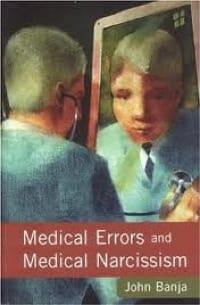

Published almost four years ago at the time of this review, it is rather interesting that other readers have not yet shared their thoughts about this book. Quite simply, this is an extremely well written, well organized text, and the subject matter is relevant to a large segment of society. Health care touches almost everyone, and understanding the mind of the health care worker, especially the physician, is important when assessing medical errors. According to author Banja, Associate Professor in the Center for Ethics at Emory University, behavior that he refers to as "medical narcissism" can have a profound influence on how the physician reacts to occurrences of such errors. Before Banja discusses narcissism in health care, he first explains error and rationalization, and follows the discussion of narcissism with chapters on forgiveness, remedies, and empathic disclosure.
The author indicates that "it is important to note that the variance, departure, or straying from the standard of care that is presently being offered as a definition of error must be morally problematic, or uncomprehending, or unintended by the actor. Simply calling an error 'a failure to accommodate the standard of care' would imply that medicine could not have progressed since Hippocrates without its practitioners making 'errors', which seems intuitively wrong. The failure to follow the standard of care, then, must be unwarranted and, overwhelmingly, the errors discussed in this book are just so". And "it is grossly unfair to hold health professionals to a standard of competence that defines 'error' in a way that exceeds ordinary and reasonable levels of performance. Because imputing error can have onerous repercussions, health professionals and especially risk managers must insist on a coherent understanding of error and resist imprecise definitions that could confuse or compromise hospital policy on patient safety and managing adverse outcomes. Consequently, the definition of error that will be used throughout this book is: 'An error is an unwarranted failure of action or judgment to accommodate the standard of care'."